This Is Better Than I Remembered!

 
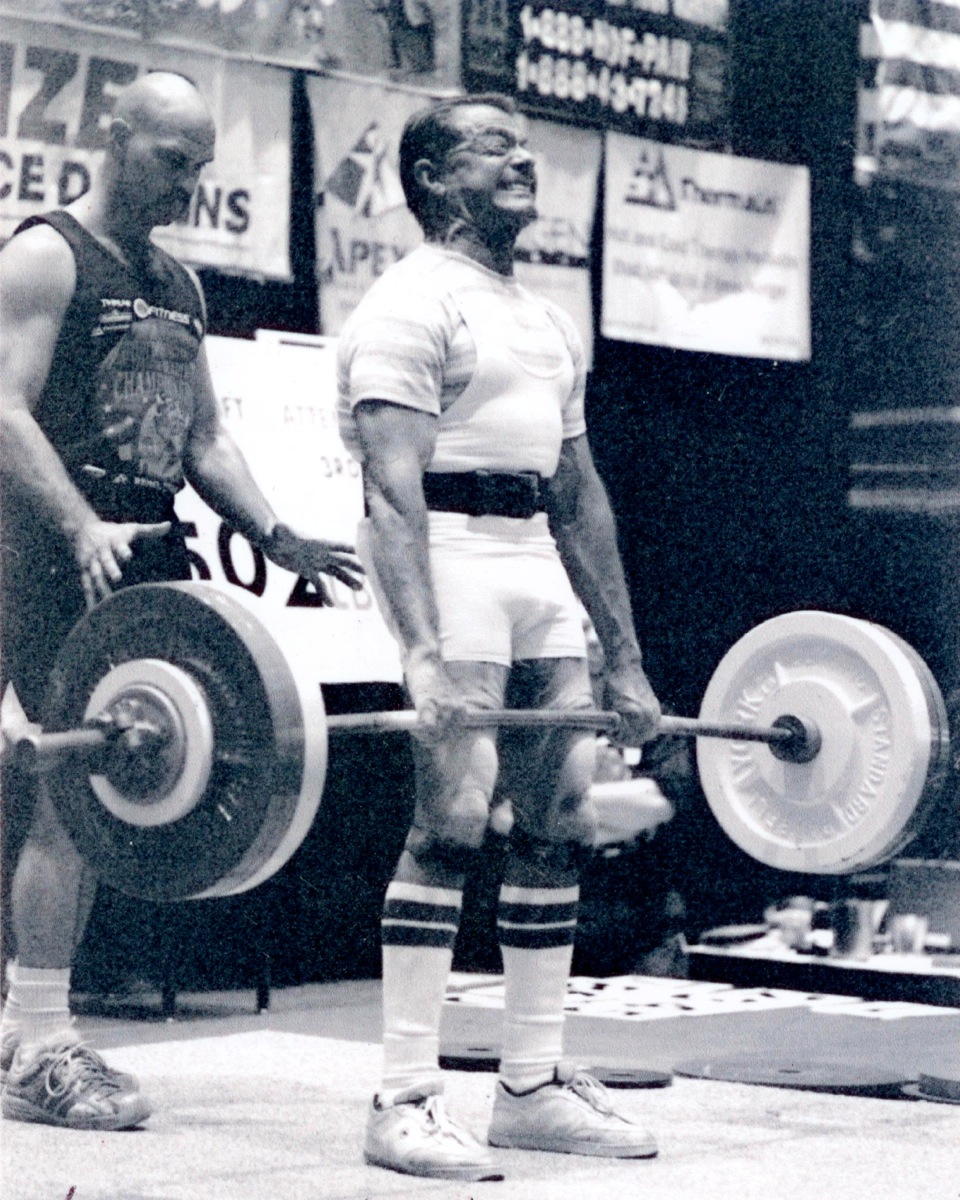
Rich Abbott pulling a heavy deadlift. I think he was in his 60's in this photo. This is what a lifetime of physical training can do for you.


Hail to the Dinosaurs!

I wrote Chalk and Sweat seven years
ago.

I wrote it to try to save an hour a day.

That's how much time I spend answering
emails from readers who ask about training
programs and workouts.

"Can you give me a good workout to build
maximum muscle mass?"

"I'm a beginner. Can you give me a good
training program?"

"I've been training for two years, and now
I want to get serious about it. What sort of
workout should I follow?"

"I only have dumbbells and an exercise
bench? Can you give me a good workout?"

"I want to use barbells, dumbbells and
sandbags, but I don't know how to work
them into a program without over-training.
Can you give me a good workout?"

"I need a good bulking up program. Can
you help me? What should I do?"

"I want to train on Olympic lifting. Can you
give me a program?"

"I need something to build all-around
strength, muscle mass and really good
condition. Can you give me a workout?"

"I can only train three days a week for
about 45 minutes. What should I do?"

"I need a two-day a week program. Do
you have one you like?"

"I need a good program for powerlifting.
Can you give me one?"

And so on.

Now, these are all good questions, and
I'd love to be able to answer them all -
but it takes time, and I'm awfully busy.

So I thought I'd put together a book that
gives you a bunch of different workouts,
with detailed. step by step instructions on
how to do them.

The result was Chalk and Sweat.

50 different workouts, using a variety of
different kinds of equipment. Training
programs for beginners, intermediates
and advanced Dinos. Special programs
for building maximum strength and
muscle mass with leg and back
specialization workouts.

I was looking at it the other day, and I
thought, "This is better than I
remembered!"

Many of you already have a copy of the
little monster. If you do, pick it up and
take a look -- you'll probably see
something you missed the first time
you read it.

If you don't have a copy, you're missing a
great little book with a ton of terrific
workouts and training tips. So go here
to grab a copy:

http://www.brookskubik.com/chalk_and_sweat.html

By the way, Workout No. 41 is a pretty
good one for advanced Dinos looking to
build some serious strength and mass.

Yours in strength,

Brooks Kubik

2.  My other books and courses are
right here at Dino Headquarters:

Hard-copy and PDF

http://www.brookskubik.com/products.html

Kindle

http://www.brookskubik.com/kindle.html

P.S. 2. Thought for the Day: "If something
is worth doing, it's worth learning how to
do it right." -- Brooks Kubik

If you enjoyed this Blog post, you'll love my Dinosaur Training books and courses. You can get them in PDF and hard-copy editions at my website or in Kindle editions at Amazon. 

For a complete list of my Kindle books, go here: http://www.brookskubik.com/kindle.html


Legacy of Iron Feedback - and the Answer to a Question!


John Grimek finishing a heavy military press at an exhibition in Los Angeles. You'll learn tons about Grimek and his training in the Legacy of Iron series.


Hail to the Dinosaurs!

Someone asked why we're putting
the Legacy of Iron books on Kindle,
since they're already available in
hard-copy format.

"Are you still selling them in hard-
copy editions?" he asked.

The answer is - yes, we are. If
you want the hard-copy editions,
go to our products page and look
for the section headed NOVELS.

You can order them one by one or
save some bucks and order all five
of them together:

http://www.brookskubik.com/products.html

And if you want a shipping quote
on multiple books, shoot me an
email and we'll get back to you.

But back to the question - why
put the Legacy of Iron books on
Kindle?

The reason is, you've been asking
for them on Kindle!

For example, here's an email from
one of our Dinos who lives in Japan:

"I recently finished your Legacy of
Iron 1, and it was great! It helped
me get back into lifting, and I
decided I wanted to learn more
about the Olympic lifts.

I just wanted to know when you'll
be releasing the other books in
the series on Kindle?

I currently live in Japan, and
although I can get them shipped,
I still prefer the mobility of the
Kindle app.

I would love to know if they will
be going on to Kindle so I can
keep reading all of the books
in the series.

They're super addictive!

Jason N."

That's why we're doing it - to help
Dinos around the world grab the
entire series without having to
pay big bucks for shipping and
handling - and for Dinos like
Jason who just prefer the
convenience and mobility
of Kindle books.

So here are the links to the first
two Legacy of Iron books in the
Kindle bookstore:

Legacy of Iron 1

http://www.brookskubik.com/legacyofiron01_kindle.html

Legacy of Iron 2 - Clouds of War

http://www.brookskubik.com/legacyofiron02_kindle.html

We'll get the others up as fast as
we can.

By the way, there's going to be at
least one more book in the series.

Rumor has it that a guy at Dino
Headquarters is already working
on it.

So if you're a Legacy of Iron fan,
you've got a lot of great reading
coming your way.

Yours in strength,

Brooks Kubik


New on Kindle from Dinosaur Training!

World and Olympic champion John Davis appears in the Legacy of Iron books - along with many other weightlifters, bodybuilders and strongmen of the 1930's, 1940's and 1950's.


Hail to the Dinosaurs!

We just added something new
to our Kindle bookstore.

It's Vol. 2 in the Legacy of Iron
series - subtitled Clouds of War.

We're going to put all five of the
Legacy of Iron books into the
Kindle bookstore, so if you
haven't read them, you're
in for a real treat.

Of course, you'll want to read
them in the proper order,
starting with Legacy of Iron (the first book in the series):

http://www.brookskubik.com/legacyofiron01_kindle.html

After that, read Legacy of Iron
2 - Clouds of War:


http://www.brookskubik.com/legacyofiron02_kindle.html

And be looking for the rest of the
books  in the series - we'll get
them up as fast as we can.

ALSO - I know you're waiting
for the next issue of The Dinosaur
Files. It should be up on Kindle
late tonight or tomorrow morning.

Yours in strength,

Brooks Kubik


Poundage Progression for Bottom Position Squats

 
Philadelphia's Louis Abele was one of the strongest men in the world back in the 1930's and 1940's. He once said that he trained his squats so hard that when his workout was over, even his teeth were aching.


Hail to the Dinosaurs!

I got an email from Nick C., who wrote:
"Hi Brooks!


I'm planning on starting a leg specialization
program that will use the bottom position
squat singles you prescribe in workout no.
39 in Chalk and Sweat.


I'm going to start with 6 x 5 with regular
Olympic squats, followed by five sets of
progressively heavier singles in the bottom
position squat.


I was wondering how you would suggest
increasing weight for this routine. Should
I try to add 5 or 10 lbs. to my top single
every week or every other week? 


Should I also be adding weight at the
same rate to the regular squats?


I guess I really want to know how you
did your weight progression on this
program when you had such great
success with it."


Thanks for your question, Nick, and
have fun with your squat program. It
will build some serious strength and
muscle. As I mention in Chalk and
Sweat
, I added almost 200 pounds
to my squat by using bottom position
squats.


BTW, in case anyone is unfamiliar
with them, bottom position squats are
performed in the power rack. You set
the bar on pins placed so it is low
enough that you can get under the
bar and start the squat from the
bottom. 


It's much harder than the conventional
way of doing squats -- which is why it
is so effective.


Of course, it's an ADVANCED training
technique. Don't use it unless you can
handle at least 300 pounds for sets of
5 reps in good, deep form.


Some people find that pause squats work
just as well or better for them than bottom
position squats. Personally, I prefer bottom
position squats for powerlifting squats
(low bar, starting from parallel), and
pause squats for OL squats (high bar,
donkey to grass full squats). I also
prefer pause squats for front squats.


Going strong at age 60 - and yes, I'm still squatting. I usually do front squats now. They work better and I can recover from them better than from back squats. Older trainees need to find the exercises that give them the most bang for the buck with the least wear and tear.

As far as progression goes, do this:

1. Start light and easy and use the first
four to six weeks as a break-in period.

a. You need to start light on the bottom
position squat. It's much harder than you
think it is. 


b. Let me repeat that - start light!

2. After you start to feel comfortable with
the exercise, train it hard and try to add five
pounds to the bar every week for as long
as you can.


3. At some point, your gains will slow
down, and it will become harder and
harder to add the five pounds. When
that happens, change the progression
to five pounds every other week. Do
that for as long as possible.


4. Try adding weight to your regular
squats at the same rate as the bottom
position squats at the start of the
program, when the weights are light.


a. When the weights get heavier, your
poundage increases on the regular squats
will be slower because the bottom position
squats are a new exercise for you, and they
have much more room for improvement.


You can try two workouts a week when
the weights are light, but one workout a
week will probably work better as the
weights get heavier.


I hope that helps, and again, have fun on
the program!


Yours in strength,

Brooks Kubik

P.S. I cover bottom position squats and other
super effective strength and mass builders
using the power rack in these books:


Dinosaur Training: Lost Secrets of Strength
and Development


http://www.brookskubik.com/dinosaur_training.html

Strength, Muscle and Power

http://www.brookskubik.com/strength_muscle_power.html

Chalk and Sweat

http://www.brookskubik.com/chalk_and_sweat.html

2.  My other books and courses are
right here at Dino Headquarters:


Hard-copy and PDF

http://www.brookskubik.com/products.html

Kindle

http://www.brookskubik.com/kindle.html

P.S. 3. Thought for the Day: "Set high
goals, and work hard to achieve them."
-- Brooks Kubik


If you enjoyed this Blog post, you'll love my Dinosaur Training books and courses. You can get them in PDF and hard-copy editions at my website or in Kindle editions at Amazon. 

For a complete list of my Kindle books, go here: http://www.brookskubik.com/kindle.html


"Am I Overtraining?" He Asked

 
World and Olympic Champion John Davis training at Muscle Beach back in the early 1950s. Those plates are real iron, and that looks like something around 400 pounds.


Hail to the Dinosaurs!

I received an email from Sean C., one
of our newer Dinos. He began training
Dino style two years ago, around age
42, and he's made really good progress.

For example, he started with the empty
bar on 20-rep squats, and now he's up
to bodyweight -- which means he's three
or four times stronger than when he
began training.

Sean asked the following question:

"The balance between intensity and
avoiding over-training seems difficult
to figure out.

Going all out for an hour or 90 minutes,
lifting heavy, concentrating, staying
focused and intense seems to conflict
with not doing too much.

How does one know where to draw the
line?"

That's a good question, and one that I
get at least once a week -- so I thought
it would be a good idea to share my
answer with everyone.

First of all, I think anyone can handle two
or three weekly workouts using a divided
workout program and an abbreviated
training schedule without running the
risk of over-training.

And I think that training for 45 to 90
minutes will work fine -- although for
many Dinos, 45 to 60 minutes is better.

Ninety minutes is a very long workout
if you're pushing hard and staying in
the zone the entire time.

Most of my workouts last about 60 to 75 minutes. Some are a little shorter, and some are a little longer.


Remember, when I give a range (such
as 45 to 90 minutes for a workout),
that does NOT mean that the upper
end of the range is better.

It's a bell curve. Some people do better
at the lower end of the curve, and some
do better at the upper end -- but most
do best right in the middle.

A 45 minute workout might be best for
20 percent of us -- a 90 minute workout
might be best for another 20 percent --
and a 60 minute workout might be best
for the remaining 60 percent.

I also think that focus, concentration,
and mental intensity are vital to your
training success. You need to use these
tools in every workout. They allow you
to make good gains with a relatively
small amount of training.

Training for 45 minutes with full focus
and deep concentration is better than
training for three hours of mindless,
haphazard work.

To find your own best range of how long
to train, then ask yourself three questions:

1. Am I making measurable progress, i.e.,
increasing what I can do in my exercises?

2. Am I enjoying my workouts and having
fun when I train?

3. Do I look forward to my workouts?

If the answer to all three questions is "Yes!"
then you're doing just what you need to be
doing -- so keep on doing it.

If the answer is "no," you need to make
changes -- which probably means to lower
your volume or intensity, or to use the
simple cycling systems I outline in Gray
Hair and Black Iron and Dinosaur Training
Secrets, Vol. 1 and 3.

In Sean's case, he's making good progress,
and he enjoys his training -- and looks forward
to each and every workout. So he should keep
on doing what he's doing.

As always, thanks for reading, and have a
great day. If you train today, make it a good
one!

Yours in strength,

Brooks Kubik

P.S. Go here to grab Gray Hair and Black
Iron:

http://www.brookskubik.com/grayhair_blackiron.html

Going strong at age 60 - using the workouts and the training ideas in Gray Hair and Black Iron.


P.S. 2. All three of my Dinosaur Training Secrets
courses are available in your choice of hard-copy,
Kindle e-book editions, or PDF with immediate
electronic delivery. You can find the links for
the format of your choice right here:

http://www.brookskubik.com/products.html

P.S. 3. Thought for the Day: "If it works,
keep on doing it." -- Brooks Kubik

If you enjoyed this Blog post, you'll love my Dinosaur Training books and courses. You can get them in PDF and hard-copy editions at my website or in Kindle editions at Amazon. 

For a complete list of my Kindle books, go here: http://www.brookskubik.com/kindle.html


The Dinosaur Files


We have tons of books and courses available in the Kindle bookstore - and we'll have another one available in the next 24 to 48 hours. Go here for the complete list, which updates every time we release something new: http://www.brookskubik.com/kindle.html


Hail to the Dinosaurs!


A number of you have been asking
about the next issue of The Dinosaur
Files.

The little monster should be available
in the Kindle bookstore sometime in
the next 24 to 48 hours.

I'll send an email when it's ready to
go. be looking for it.

We're going to release this issue in
Kindle format only, so don't wait for
a PDF edition - just grab the Kindle
edition.

There are several reasons for this.

First, Kindle is much faster and
easier to work in. So releasing
new products in Kindle format
lets me devote more time to
writing, researching and
creating new products for
you.

Second, we don't have piracy
problems with Kindle books.
We do have them with PDF
products.

Third, Amazon has a free app
that allows you to read Kindle
books on any device - so you
don't need a Kindle reader. You
can read the Dino Files in Kindle
format on any device.

Kindle is actually easy to use,
and has some great features
for older Dinos. For example,
you can increase the size of
the font to anything you like.
So it's always easy to read.

And, of course, you can store
hundreds of Kindle books in
the Cloud - and retrieve them
whenever you want. So you
carry a library with you
wherever you go.

If you haven't yet tried Kindle
products, do this - head on over
to the following page in the Kindle
bookstore and grab John Wood's
new book:

Old-School Strength Articles,
Vol. 1

http://www.oldtimestrongman.com/oldschoolarticles001.html

It's got five great articles from
Peary Rader's old Iron Man
magazine - and it costs just
$2.99.

So you can spend $2.99, grab a
great little book, and see how the
whole Kindle thing works - and how
easy it is.

After that, you can grab some of
my new books on Kindle - again,
just to learn how to do it, and
see how easy it is and how well
it works.

For example. you'll like these:

Brooks Kubik's Strength Training
Q and A, Vol. 1

http://www.brookskubik.com/oldschool_01-kindle.html

The Dinosaur Strength Training
Notebook, Vol. 1

http://www.brookskubik.com/dinosaurnotebook001.html

Also go right here and take a
look at all of my different books
and courses available on Kindle:

http://www.brookskubik.com/kindle.html

As you can see, there's a ton of
great books available - with more
coming all the time.

Anyhow, be looking for the new issue
of the Dino Files - it's a good one -
and it's coming soon!

Yours in strength,

Brooks Kubik


How to Stay Out of the Danger Zone!

 
John Grimek and other old-school champions  followed slow-cooking progression systems.


Hail to the Dinosaurs!

I saw an interesting article the other day
reporting on several recent research studies
that looked at the effect of different factors
on injuries suffered by (1) runners and (2)
rugby players.

Now, I know that running and rugby are
different than strength training, but bear
with me. There was some good information
for us.

In both studies, the researchers found that
the greatest risk of injury occurred when
there was a sudden increase in the amount
or intensity of one's training.

An increase of just 20 percent was enough
to put an athlete into the danger zone -- and
an increase of 40 percent or more would
increase the risk of injury by about three
to four times.

Now, you may think, "That's fine -- but who
would ever increase their training volume or
intensity by 20 to 40 percent?"

That's a fair question.

Here's the answer.

We've all done it.

Beginners do it all the time. They go from no
training to "lots of training" (usually far too
much). That's why beginners need to start
light and easy, and train progressively, with
slow and steady increases in both volume
and  intensity.

Other trainees do it when they come back from
a lay-off. Once again, they go from zero training
to "lots" of training, and usually do it without
any kind of break-in period or any sort of
systematic progression.

Many trainees do it when they go on specialization
programs. You see it happen all the time.

Trainees do it when they go on crash weight loss
programs and start doing high volume workouts
to "burn off the flab".

Trainees do it when they add cardio to their
strength training programs. They go from three
training days a week to six (three days of
strength training and three days of cardio).

I could go on with many more examples, but
you get the point.

Going strong at age 60 - in large part because I've followed old-school workouts and old-school progression systems for most of my career.


So how do you stay out of the danger zone?
It's simple.

You follow old-school, "slow cooking" progression
methods. You increase your volume and your
intensity at a pace your body can handle. You
give your body the time it needs to adapt to
any increases in volume or intensity.

In other words, you follow the slow and steady
approach.

Not the crash and burn approach.

It sounds simple. But it works. And it's one of
the secrets of lifelong strength and health.

As always, thanks for reading and have a
great day. If you train today, make it a good
one -- and stay in the gaining zone, not the
danger zone!

Yours in strength,

Brooks Kubik

P.S. The progression systems in Dinosaur
Training Secrets, Vol. 3, will keep you on
the right track -- and keep you out of the
danger zone!

Hard-copy

http://www.brookskubik.com/dinosaur_secrets_03.html

Kindle e-book

http://www.brookskubik.com/dinosaur_secrets3_kindle.html

PDF with electronic delivery

http://www.brookskubik.com/dinosaursecrets_vol3_digital.html

2.  My other books and courses are
right here at Dino Headquarters:

Hard-copy and PDF

http://www.brookskubik.com/products.html

Kindle

http://www.brookskubik.com/kindle.html
P.S. 3. Thought for the Day: "Do it one rep
at a time and one pound at a time."
-- Brooks Kubik


If you enjoyed this Blog post, you'll love my Dinosaur Training books and courses. You can get them in PDF and hard-copy editions at my website or in Kindle editions at Amazon. 

For a complete list of my Kindle books, go here: http://www.brookskubik.com/kindle.html